
How to Read Your Eyeglass Prescription: Terms, PD, & Segment HeightUpdated 2 hours ago
Understanding your eyeglass prescription makes ordering custom Single Vision or Progressive replacement lenses fast and accurate. Below is a complete guide to reading your prescription chart, measuring your Pupillary Distance (PD), and calculating Segment Height (SH) for progressive lenses at home.
Decoding Your Prescription Chart
| Prescription Term | Abbreviation | What It Means |
| Right Eye / Left Eye | OD / OS | Latin for Oculus Dexter (Right Eye) and Oculus Sinister (Left Eye). You may also see RE / LE or OU (Oculus Uterque = Both Eyes). |
| Sphere | SPH | Primary lens power measured in diopters (D). A minus sign (-) corrects nearsightedness (distance); a plus sign (+) corrects farsightedness (near vision). |
| Cylinder | CYL | Amount of lens power added to correct astigmatism (irregular curvature of the eye). Can be negative or positive. |
| Axis | AXIS | The angle (from 1 to 180 degrees) determining where the cylinder power is positioned to correct astigmatism. Often preceded by an "X". |
| Add | ADD | The added magnifying power applied to the bottom of progressive lenses to assist with reading and close-up vision. |
| Prism | PRISM | Special power measured in prism diopters (p.d.) used to correct eye alignment. Accompanied by a direction: BU (Up), BD (Down), BI (In toward nose), or BO (Out toward ear). |
Pupillary Distance (PD): Explanation & DIY Measurement
Pupillary Distance (PD) is the measurement in millimeters (mm) between the center of one pupil to the center of the other. Because lenses feature a slight optical curve, accurate PD alignment ensures light focuses properly on your eyes.
Warning for High Prescriptions: Incorrect PD alignment can cause "induced prism," leading to eye strain, blurriness, or severe headaches.
Single PD vs. Dual PD
Single PD (Binocular): The total millimeter distance from pupil center to pupil center (average adult range: 54mm to 74mm; child range: 43mm to 54mm).
Dual PD (Monocular): Two numbers representing the distance from the center of your nose bridge to each eye individually (e.g., 31/32). Dual PD accounts for slight facial asymmetry and offers maximum accuracy.
How to Measure Single PD at Home (Mirror or Friend)
Hold a millimeter ruler flat across your brow line.
Close your right eye and line up the ruler's 0mm mark directly with the center of your left pupil.
Without moving the ruler, open your right eye and close your left eye.
Read the millimeter mark that aligns with the center of your right pupil. That number is your Single PD!
How to Measure PD Using Existing Glasses
Put on your glasses and grab a washable felt-tip marker.
Focus on a stationary object at least 20 feet away.
Close your left eye and place a small dot on the right lens directly over the object.
Close your right eye and place a dot on the left lens over the object.
Open both eyes; the two dots should merge into a single dot in your view.
Remove your glasses and measure the distance between the two dots in millimeters.

Segment Height (SH): Progressive Lens Fitting
Segment Height (SH) is the vertical distance in millimeters from the bottom edge of the lens to the center of your pupil. Segment height is required when ordering Progressive lenses to ensure the reading transition zone begins at the correct height. (Segment height does not apply to single vision lenses).
How to Measure Segment Height at Home
Put on the specific sunglass frames you plan to use for your progressive lenses.
Stand 8 inches away from a well-lit mirror, looking straight ahead.
Hold a millimeter ruler vertically against your lens.
Align the 0mm mark with the bottom of the lens (not the bottom of the outer frame rim).
Measure straight up to the exact center of your pupil.
Repeat 2–3 times to verify accuracy.
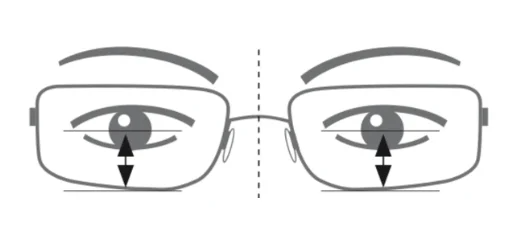
Note on Frame Changes: Segment height is unique to both your face and the specific frame geometry. Always measure segment height on the exact frame you are sending in rather than reusing old numbers! It may be best to have someone assist with the measurement, to ensure it is measured correctly.
Frequently Asked Questions
What if my doctor did not write my PD on my prescription?
Eye doctors do not always include PD on standard prescription scripts, but you can easily measure it yourself using a millimeter ruler or our glasses-marking method above.
Is segment height the same as lens height?
No. Lens height measures the full vertical size of the lens, whereas Segment Height measures specifically from the bottom of the lens to your pupil center.
Does Fuse make traditional lined bifocals?
No. Fuse specializes in line-free Progressive lenses and Single Vision lenses.